
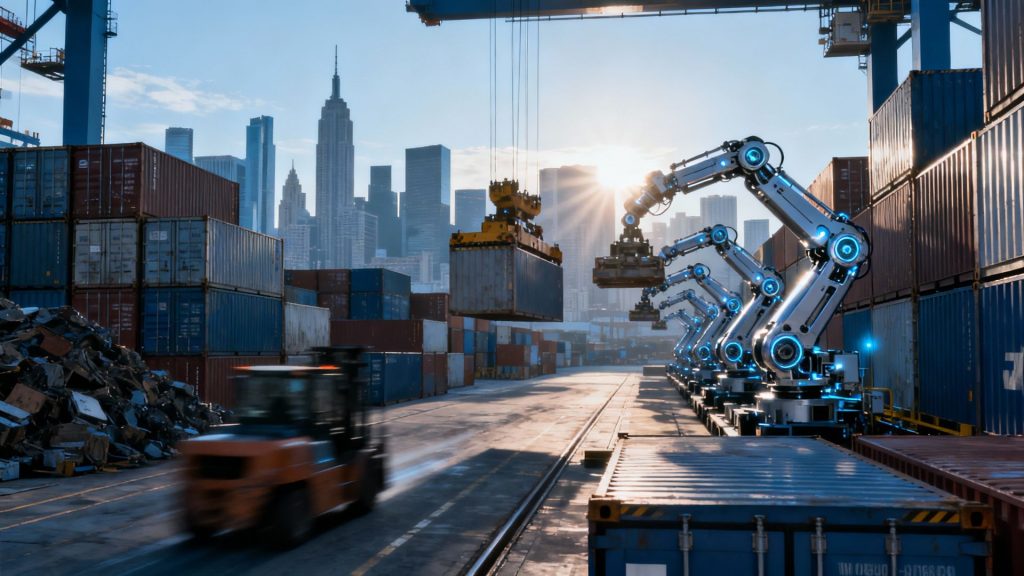
The Global Economy’s Tightrope Walk: Inflation, Trade Wars and the AI Revolution
As central banks diverge on rates and tariffs cloud the horizon, the world economy faces its most complex balancing act in decades.
Global growth is stuttering under the weight of persistent inflation and trade fragmentation, with the IMF’s April outlook trimming 2025 projections to 2.7% as supply chains convulse. Energy prices remain volatile anchors, dragging industrial output into contraction across Europe while emerging markets grapple with currency tremors. This fragile equilibrium emerges against a backdrop where Red Sea disruptions have added 15% to shipping costs, reigniting fears of secondary inflation waves.
Monetary policy schisms deepen as the ECB’s surprise 25-basis-point cut in March contrasts with the Fed’s continued hawkish pause. “We’re navigating without synchronized compasses,” remarked a BIS economist, noting how eurozone stagnation forced Draghi’s hand while Powell awaits clearer disinflation signals. The divergence creates currency crosscurrents that have already erased $2.1 trillion from global forex reserves this quarter, pressuring export-dependent economies.
Trade tensions escalate as the U.S. imposes 50% tariffs on Chinese EVs and solar panels, triggering Beijing’s retaliatory rare-earth export controls. Supply chain maps are being redrawn overnight, with Vietnam and Mexico emerging as alternative manufacturing hubs. The WTO warns such fragmentation could permanently reduce global GDP by 5% through duplicated infrastructure and regulatory misalignment.
Generative AI emerges as both disruptor and savior, with productivity gains projected to offset 0.8% of GDP losses from trade realignments. Yet the technology’s lightning adoption strains labor markets, where ILO data shows 40% of white-collar roles now face automation risks. Central bankers increasingly reference the “AI inflation paradox”—where cost reductions in services battle wage pressures from displaced workers.
Commodity markets flash warning signals as copper’s 18% April surge—the metal’s steepest monthly gain since 2021—signals both green transition demand and speculative froth. Simultaneously, agricultural futures spike as climate disruptions slash South American harvests, reminding policymakers that food inflation remains the most politically combustible variable.
The path forward requires unprecedented policy coordination, with IMF head Georgieva urging “targeted fiscal buffers” to cushion vulnerable populations. Digital currencies offer glimmers of hope, with cross-border CBDC trials accelerating payment efficiency, yet their deployment risks fragmenting monetary sovereignty further. As interest rate paths diverge like tributaries in a storm, the global economy’s resilience hinges on avoiding policy missteps that could trigger synchronized downturns.