
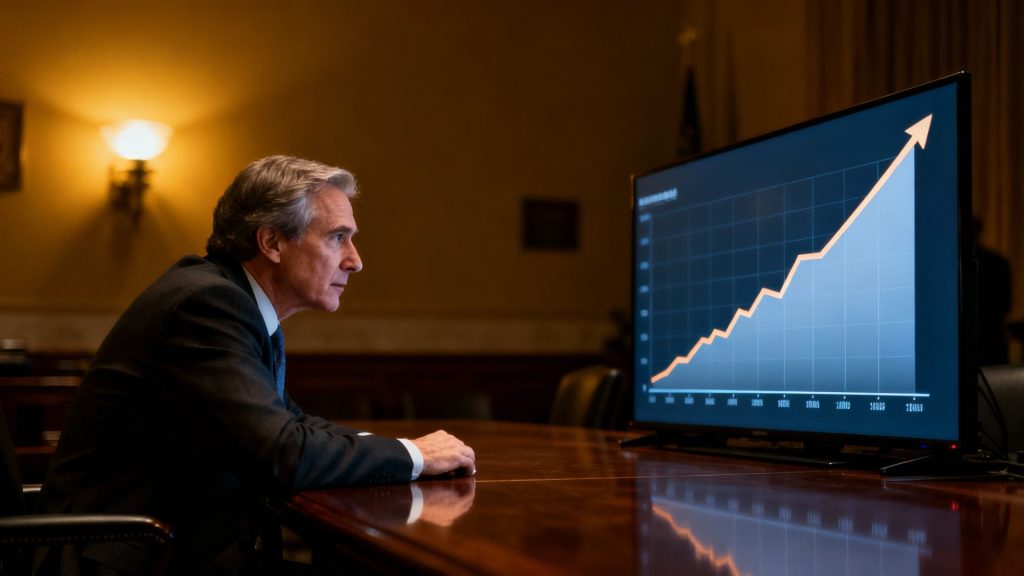
Inflation’s Grip Tightens: Central Banks Navigate the Precarious Path Between Growth and Stability
Core CPI remains stubbornly elevated as policymakers wrestle with interest rate decisions amid slowing global growth and geopolitical turbulence
October’s economic data reveals a world economy caught in conflicting crosscurrents, with the IMF revising global growth projections downward to 2.9% for 2024 while US core inflation persisted at 4.0%. The Federal Reserve’s latest pause in rate hikes reflects deepening concerns about over-tightening, yet European Central Bank President Christine Lagarde maintains “we are not done fighting inflation.” Commodity price fluctuations, exemplified by Brent crude’s 6% monthly swing, continue feeding cost-push pressures across manufacturing sectors. This economic paradox – cooling expansion alongside persistent price pressures – forms the backdrop against which policymakers must chart their course.
The Federal Reserve’s balancing act grows increasingly complex as retail sales dipped 0.1% last month despite resilient employment figures. Chair Jerome Powell acknowledged the dilemma: “We’re walking a narrow path” between curbing inflation and avoiding recession. Treasury yield curves remain inverted, signaling market skepticism about soft landing prospects. Meanwhile, emerging markets face amplified challenges – Brazil’s central bank unexpectedly cut rates by 50bps, while Turkey’s monetary authority delivered a staggering 500bps hike. These divergent approaches underscore the absence of unified global strategy.
Europe presents a particularly fractured landscape, with Germany’s economy contracting 0.1% in Q3 while Spain expanded 0.3%. Energy prices remain the ghost haunting European industry, as evidenced by BASF’s recent profit warning citing unsustainable gas costs. The ECB’s latest lending survey shows credit demand plummeting to record lows, suggesting monetary transmission has outstripped expectations. Supply chain analytics reveal automotive production delays stretching to 11 weeks – nearly double pre-pandemic averages – as manufacturers reconfigure logistics routes around conflicts.
Trade data paints a more troubling picture, with global goods exports declining for five consecutive months. Semiconductor shipments – the modern economic canary – fell 4.5% year-on-year. Container shipping rates from Asia to Europe have inexplicably surged 142% since August, a ripple effect from maritime security disruptions. Chinese export figures surprised positively, however, with EV shipments jumping 60% to record levels. This illustrates the bifurcation between traditional manufacturing and emerging green technologies that increasingly defines trade patterns.
The digital economy’s evolution offers both risk and respite. Blockchain settlement volumes in cross-border transactions grew 45% last quarter, reducing traditional banking friction. Yet cybersecurity incidents targeting financial infrastructure increased threefold, with AI-enabled attacks compromising payment systems. Central bank digital currency experiments advance cautiously, with 13 nations now in pilot phases. Algorithmic trading now accounts for 85% of equities volume – a double-edged sword providing liquidity but amplifying volatility during market stress events.
Policymakers confront unprecedented structural challenges. Labor market tightness persists despite tech layoffs, with US job openings still exceeding unemployed workers by 3 million. Productivity growth remains elusive, stuck at 1.1% across advanced economies. The IMF warns of fiscal exhaustion, estimating 60% of nations now exceed debt sustainability thresholds. Geopolitical fissures manifest in capital flows – foreign direct investment into China declined 34% last quarter while India saw record inflows. This investment divergence signals supply chain realignments with profound long-term consequences.
Navigating the quarters ahead demands unprecedented policy agility. The tightening cycle’s delayed effects continue transmitting through economies, while financial stability risks accumulate in commercial real estate and private credit markets. Digital currency innovations offer promising payment system modernization, yet introduce new vectors for systemic vulnerability. Should inflation persistence force renewed monetary aggression, the global economy may face a coordinated slowdown – making the current policy calibration perhaps the most consequential since the Volcker era.