
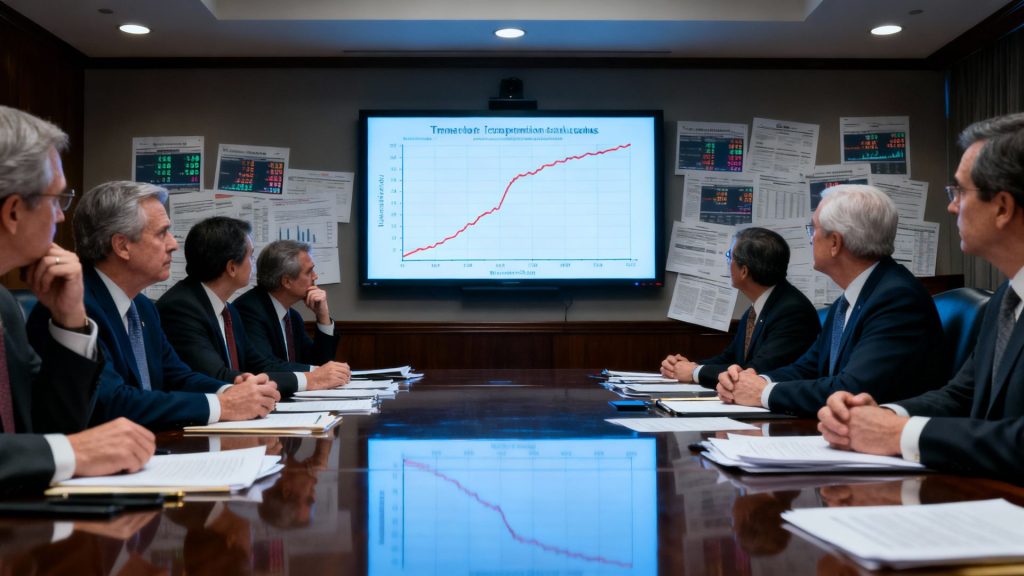
Stagflation’s Grip Tightens: Central Banks Navigate Inflationary Rapids Amid Faltering Growth
As major economies wrestle with persistent price pressures and cooling demand, policymakers face agonizing trade-offs between curbing inflation and avoiding recessionary undertows.
The global economic landscape enters mid-2025 defined by contradictory signals: while US inflation unexpectedly ticked up to 3.4% in June according to Bureau of Labor Statistics data, Eurozone GDP growth stagnated at 0.2% for Q2, revealing fault lines beneath surface-level recovery narratives. This economic paradox forces central bankers into complex policy triage, balancing aggressive monetary tightening against recessionary storm clouds gathering over Germany and Japan’s export-dependent economies.
Federal Reserve Chair Jerome Powell’s recent congressional testimony struck a sober tone, acknowledging that “the disinflation process has encountered unexpected resistance” as service sector inflation proves stubbornly persistent. With markets now pricing in just one rate cut for 2025 versus three projected in January, the policy divergence widens as the European Central Bank proceeds with cautious reductions while emerging markets like Turkey implement emergency 500-basis-point hikes to defend collapsing currencies.
Supply chain volatility remains the invisible hand throttling price stability, with Red Sea shipping disruptions adding 1.2 percentage points to European import costs according to UNCTAD assessments. The manufacturing sector’s recovery falters under this pressure, with global PMI indices retreating to contraction territory (48.6) for the first time in 18 months. Industry analysts observe factories becoming reluctant inventory managers, scaling back orders amid demand uncertainty that ripples through Asian electronics corridors.
Artificial intelligence emerges as the wildcard in productivity calculations, with IMF studies suggesting AI adoption could boost global GDP by $4.4 trillion annually by 2030. However, this digital transformation accelerates labor market polarization, displacing routine cognitive tasks while creating premium roles requiring advanced technical literacy – a dichotomy visible in Wall Street firms deploying algorithmic traders while retail banks shutter branches. The skills gap widens into an economic chasm, with OECD data showing 65% of employers reporting tech talent shortages.
Geopolitical fractures compound economic fragility, as evidenced by the 17% quarter-on-quarter contraction in EU-China photovoltaic trade following new anti-dumping duties. Such protectionist measures threaten to fragment green technology supply chains precisely when climate investments require accelerated global coordination. World Bank projections indicate these trade frictions could shave 0.8 percentage points from worldwide growth in 2026 if current trajectories persist.
Capital markets exhibit schizophrenic tendencies, with sovereign bond yields seesawing on shifting rate expectations while corporate debt issuance hits record highs. This credit boom masks underlying vulnerabilities, particularly in commercial real estate where $1.3 trillion in loans mature by end-2025. The divergence between resilient equity indices and widening high-yield spreads suggests investors are pricing in multiple conflicting scenarios simultaneously, creating unstable valuation foundations.
Policymakers now confront the hydra-headed challenge of simultaneously managing inflation containment, financial stability preservation, and climate transition funding. The coming quarters demand unprecedented policy coordination to prevent the current stagnation from hardening into entrenched stagflation. As global economic architects redesign the monetary playbook, their decisions will determine whether 2025 becomes a pivot toward renewal or a prelude to prolonged malaise.