
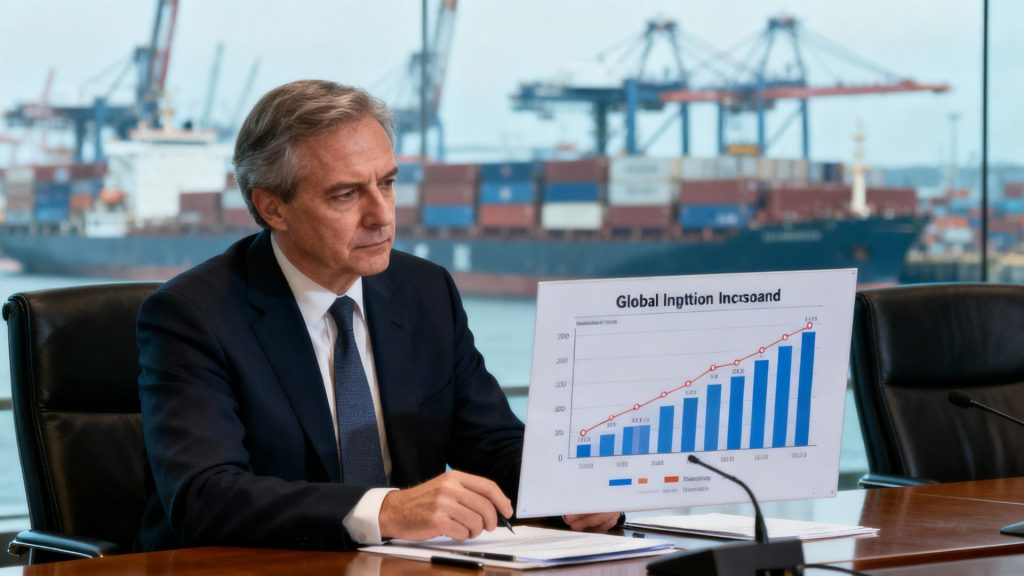
Global Inflation’s Stubborn Grip: Central Banks Walk Monetary Tightrope Amid Trade Tremors
As supply chain fractures deepen and AI-driven productivity sparks sectoral imbalances, policymakers face unprecedented dilemmas in stabilizing economies
Fresh data from May reveals global inflation hovering at 5.8%, defying earlier forecasts as energy shocks ripple through European markets while US core CPI remains stubbornly elevated. The International Monetary Fund’s revised growth projection of 2.9% for 2024 underscores what Managing Director Kristalina Georgieva terms “synchronized stagnation” – a phenomenon where 78% of economies experience cooling output despite persistent price pressures. This economic paradox emerges as shipping container rates from Shanghai to Rotterdam surge 120% quarterly, creating what analysts call “inflationary whiplash” across manufacturing hubs.
Monetary authorities confront agonizing trade-offs: the European Central Bank’s 25-basis-point June cut contrasts sharply with the Federal Reserve’s delayed pivot, creating what BIS termed “policy divergence vortex”. “We’re navigating without historical compasses,” admits ECB President Christine Lagarde, referencing how traditional Phillips curve models fail to capture AI’s deflationary impact on tech sectors versus energy-intensive industries. This asymmetry manifests in Germany’s industrial production contracting 0.7% while French AI startups secure record $4.2B funding – a bifurcation forcing central banks into sector-targeted liquidity operations.
Global trade patterns undergo seismic realignment as evidenced by Vietnam’s 19% export plunge to the EU, coinciding with Mexico surpassing China as America’s top goods supplier for the first time since 2002. The reshuffling triggers what WTO Director-General Ngozi Okonjo-Iweala calls “supply chain arrhythmia”, with automotive plants in Slovakia idling amid semiconductor shortages while Indian pharmaceutical exports boom. These dislocations crystallize in Baltic Dry Index fluctuations exceeding 30% weekly – volatility that Morgan Stanley analysts warn could erase $2.3 trillion from global GDP if unresolved.
Artificial intelligence emerges as both disruptor and stabilizer, with generative AI adoption accelerating productivity in financial services (17% efficiency gains reported by JPMorgan) yet exacerbating labor market polarization. The OECD’s June report highlights AI’s “double-edged sword” effect: while automating 28% of routine tasks, it simultaneously creates skills mismatches affecting 34% of OECD workforces. This technological transformation coincides with critical mineral supply bottlenecks, where lithium prices swing 40% monthly – volatility that threatens to derail green energy transitions.
Forward-looking indicators suggest mounting vulnerabilities: credit default swaps for emerging markets have widened to 2020 levels, while inverted yield curves persist across 90% of G10 economies. “The runway for soft landings is shortening,” cautions former Fed Chair Ben Bernanke, pointing to corporate debt maturity walls exceeding $1.9 trillion through 2025. Geopolitical flashpoints compound risks, with Red Sea disruptions adding 14 days to Asia-Europe shipping and potentially adding 0.6% to Eurozone inflation according to Bloomberg Economics models.
This complex tableau reveals an interconnected system straining under contradictory forces: digital deflation versus commodity inflation, labor scarcity alongside technological unemployment, and green transition ambitions clashing with resource nationalism. As capital flows fragment into competing blocs, the coming quarters will test whether multilateral frameworks can adapt swiftly enough to prevent what the World Bank grimly projects as “the lost decade of development”.